Guide
What an Apostille Actually Is
A one-page certificate that says a signature is genuine — and says nothing at all about what the document claims.
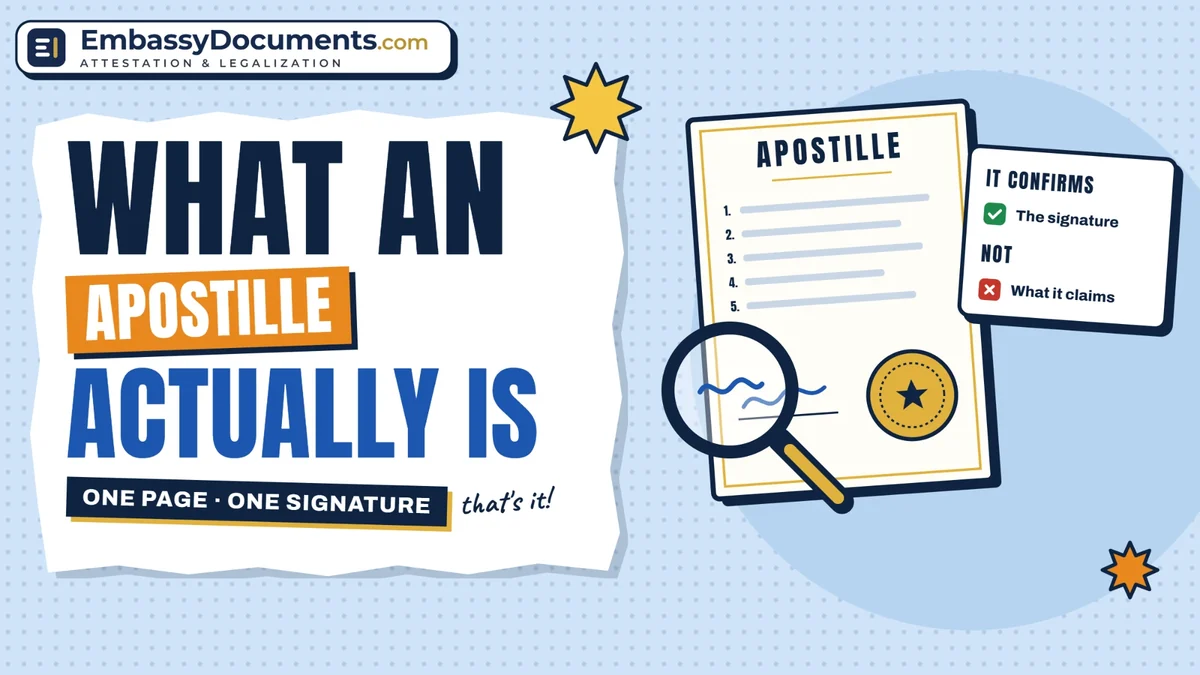
An apostille is a certificate attached to a public document by the country that issued it, confirming that the document is a genuine official document of that country. In India it is issued by the Ministry of External Affairs, as a sticker applied to the back.
That is the whole of it. It is a short, standardised certificate with a fixed set of fields, and the reason it exists is to spare you a longer process. What trips people up is not what an apostille is, but what they assume it proves.
What it certifies, and what it does not
This is the part worth reading twice, because it is the source of almost every misunderstanding.
An apostille certifies three things and only three: that the signature on the document is genuine, that the person who signed had the capacity to sign it, and that any seal or stamp on it is the real one. That is set out in the Convention itself.
- It does not certify the contents. An apostille on a degree does not say you hold that degree, or that the marks are correct, or that the university is reputable. It says the registrar’s signature is really the registrar’s.
- It does not make a document valid. A certificate that has expired, been superseded or was issued in error is just as invalid with an apostille on it.
- It does not translate anything. If the receiving authority needs the document in another language, that is a separate job, usually done afterwards.
- It does not oblige anyone to accept the document. It removes the question of authenticity. Whether the document satisfies a visa rule, a licensing body or an employer is a different question entirely.
So an apostille is narrower than most people think, and that narrowness is deliberate. The foreign authority reading your document does not have to know what an Indian university registrar’s signature looks like. The apostille answers that one question so they can get on with the rest.
What is actually on it
An apostille is not free text. The Convention fixes the format, which is why one issued in India is recognisable to an official in Italy who has never seen an Indian document before.
It carries the issuing country, who signed the underlying document and in what capacity, whose seal it bears, the place and date of the apostille, the authority issuing it, a serial number, and that authority’s own seal and signature.
The serial number matters more than it looks. It is what lets the receiving authority check the apostille against the issuing country’s register, which is how a forged one is caught. If you want to know what each mark on a returned document means, that is covered in every stamp on your attested document.
Why it exists at all
Before 1961, using a document abroad meant a chain: your own authorities certified it, then your foreign ministry, then the destination country’s embassy, and sometimes its foreign ministry after that. Every link cost time and money, and every link was a place to fail.
The Hague Convention of 5 October 1961 replaced that chain, between its members, with a single certificate. India joined in 2005. For a destination inside the Convention, one MEA sticker now does the work the whole chain used to.
For a destination outside it, nothing changed: the old chain is still the route, and that is what apostille versus attestation sets out.
Where an Indian apostille works, and where it does not
The Convention has 130 members, but that is not the number that matters to you. An Indian apostille is accepted in 127 countries.
The gap is the part almost no one explains. A country can be a full member and still refuse an apostille issued in India, because it objected to India joining and never withdrew the objection. Two countries are in that position: China and Germany. Documents for either need a different route, whatever a membership list tells you.
The current position for every destination is on our country-by-country table, checked against the HCCH status list.
What an apostille is not
- Not attestation. Attestation is the longer chain used for countries outside the Convention, ending with that country’s embassy and often its foreign ministry.
- Not notarisation. A notary witnesses a signature or certifies a copy. That sometimes happens before an apostille, on documents that are not already public records, but it is a different act by a different person.
- Not a visa, a licence or a recognition decision. Equivalency of a degree, registration with a professional council and immigration approval are all separate processes with their own authorities.
Who issues it in India
Only the Ministry of External Affairs. No state government, no notary, no agency and no consultancy can issue an apostille, and anyone who says otherwise is describing something else.
What happens before the MEA stage depends on the document. Educational certificates are verified by the state HRD or equivalent first; personal documents by the Home Department or an SDM; commercial documents by a Chamber of Commerce. Only then does the MEA apply the apostille.
We handle that sequence end to end, including for clients who are already abroad. If you are not sure which route your document needs, send us a scan and ask.
Questions
Frequently asked questions
It is the French word for an annotation or note in the margin, and it is used because the certificate was named in the French text of the 1961 Hague Convention. In practice it means the certificate itself: the sticker or printed page attached to a document confirming that the signature and seal on it are genuine.
To let a document issued in one country be accepted as genuine in another without a chain of embassy legalisations. It answers one question - is this a real official document of that country - so the receiving authority does not have to verify an unfamiliar signature itself.
It proves the signature and seal on it are genuine, which is not quite the same thing. An apostille confirms that the official who signed really holds that office and that the seal is the real one. It makes no statement about the contents, so it does not certify that you hold the qualification the document describes.
The apostille itself has no expiry date. What varies is the receiving authority: some will not accept a document apostilled more than three or six months ago, which is a rule of theirs rather than a property of the apostille. Check what the authority asking for it currently requires before reusing an older document.
The format is, which is the point of it. The Convention fixes the fields, so an apostille issued by the MEA in New Delhi carries the same information in the same order as one issued in Rome or Washington. What differs is the physical form - a sticker in India, a printed page or a digital certificate elsewhere.
It depends on the document. Apostilles go on public documents, so an original registrar-issued certificate is the straightforward case. A photocopy nobody has certified cannot be apostilled; a copy that a notary has certified sometimes can, because the notarisation is itself a public act. Tell us which document you have and we will say which applies.
The destination decides, not the document. Members of the Convention that accept an Indian apostille take the single MEA sticker. Countries outside it need the full chain, ending at that country’s embassy in New Delhi and often its foreign ministry afterwards. Our apostille versus attestation guide sets out which applies where.
Not sure where to start?
Send us the document and the destination country. We will reply within one working hour with the exact process, timeline and cost.