Guide
MEA Apostille vs MEA Attestation: Which Do You Need?
Two different routes, and picking the wrong one costs you weeks. Here is how to tell which one your destination actually wants.
The short answer
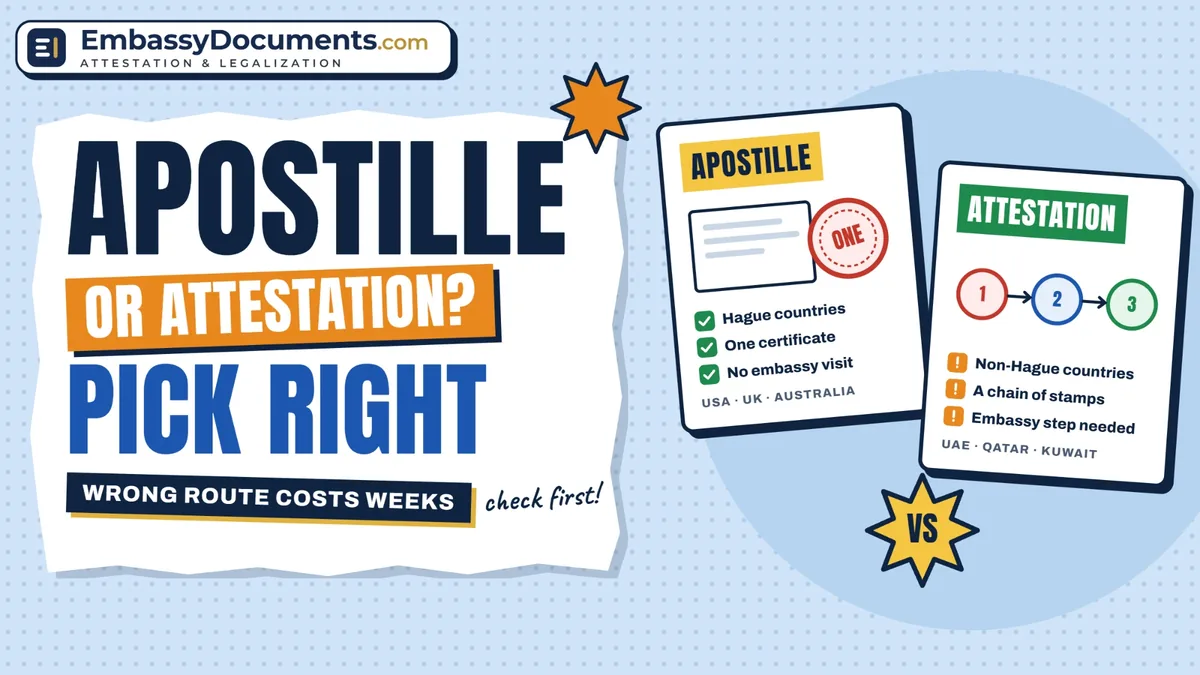
If the country your document is going to is a member of the Hague Apostille Convention, you need an MEA apostille: one certificate, and the document is ready to use.
If it is not a member, you need attestation: the MEA stamps the document, and then that country's embassy in New Delhi legalises it. Some countries add a further step once the document arrives.
There are a handful of exceptions where a country is a Convention member but still will not accept an Indian apostille. They are covered further down, and they matter more than their number suggests.
What an MEA apostille is
An apostille is a single certificate issued by the Ministry of External Affairs in New Delhi. It confirms that the signature and seal on your document are genuine. Every country in the 1961 Hague Apostille Convention agrees to accept it without asking for anything further.
India has been a member since 2005, so Indian public documents can be apostilled here for use in other member countries. In practice this covers the USA, the UK, Australia, most of Europe, and a growing list elsewhere.
It is a printed sticker fixed to the back of the document, with a unique number. Nothing on the face of your certificate changes.
What MEA attestation is
Attestation is the older route, used for countries outside the Convention. It is a chain rather than a single certificate.
- State authentication first, by the department that can vouch for the issuing body: the HRD or education department for degrees, the Home Department or GAD for personal documents, a Chamber of Commerce for commercial papers.
- MEA attestation, which verifies the state stamp.
- Embassy legalisation, by the destination country's embassy or consulate in New Delhi.
- A final step in the destination country for some places. The UAE, Qatar and Kuwait each want their own foreign ministry to see the document after it arrives.
Each link in that chain has its own queue, which is why attestation routinely takes longer than an apostille for the same document.
The two routes side by side
- Who it is for. Apostille for Convention members; attestation for everyone else.
- What you end up with. Apostille: one sticker. Attestation: an MEA stamp followed by an embassy stamp, sometimes a third stamp abroad.
- Embassy visit. Not needed for an apostille. Unavoidable for attestation.
- Time. Both depend on the state stage, which is the slow part either way. Attestation then adds the embassy queue on top.
What does not change between them is the beginning. Both routes start with state-level authentication, and both are refused without it.
Which route your destination needs
- Apostille. The USA, the UK, Australia, France, Italy, Spain, the Netherlands and most of Europe. Among the Gulf states, Saudi Arabia (since December 2022), Oman and Bahrain.
- Attestation plus embassy legalisation. The UAE, Qatar and Kuwait, none of which are Convention members. The UAE and Qatar then want MOFA attestation in the destination country as a final step.
- Attestation despite membership. China and Germany, for the reasons in the next section.
Membership changes. Saudi Arabia moved from attestation to apostille in December 2022, and plenty of advice online has not caught up. Check before you start, or ask us and we will check for you.
Three exceptions worth knowing
A country being in the Convention is usually enough. Occasionally it is not, because the Convention only applies between two members if neither has objected to the other joining.
- Germany. A Convention member, but it objected to India's accession and has never withdrawn the objection. An Indian apostille is not accepted in Germany. Germany also does not legalise Indian documents through its embassy in the usual way: it verifies them with the issuing authority directly instead, which is a slower and quite different process.
- China. China joined in November 2023, but India objected to its accession in September 2023. The Convention does not apply between the two, so documents for China still need MEA attestation followed by Chinese embassy legalisation.
- Thailand. Not yet in force. Thailand becomes a Convention member on 28 February 2027. Until that date, documents for Thailand follow the attestation route.
These are the cases where confidently following general advice gets a document refused abroad after you have already paid for it.
Mistakes that cause rejections
- Getting an apostille for a non-member country. For the UAE, an apostille does not finish the job. It can serve as a step along the way, but the embassy legalisation and MOFA stages still have to happen, and an apostille on its own will be refused.
- Skipping state authentication. Both routes need it. The MEA will not look at a document that has not been verified by the state that issued it.
- Treating all documents the same. Educational, personal and commercial documents each take a different path before they reach the MEA, through the HRD department, the Home Department and a Chamber of Commerce respectively.
- Assuming last year's rules. Convention membership moves. So does what individual receiving authorities will accept.
- An incomplete set. Send the original, a photocopy, and a copy of your passport. Missing pieces stall a file at the first desk it reaches.
What about e-Sanad?
e-Sanad is the MEA's online platform for documents that can be verified digitally at source, which removes some of the physical back-and-forth at the state stage. Where it works, it helps.
It helps on the apostille side. A document bound for the UAE still follows the physical chain through the embassy and MOFA afterwards, because those stamps are not something an Indian platform can issue.
Whether your particular document is eligible depends on the issuing university or authority being connected to the system. Many are not yet. We will tell you which case yours is rather than letting you find out after you have applied.
Questions
Frequently asked questions
Neither, in the abstract. Your destination decides. If it is a Convention member, the apostille route is better simply because it is one certificate instead of a chain. If it is not, an apostille alone will not be accepted, however much simpler it would be.
The MEA stage itself is quick. The slow part is the state authentication before it, which varies by state and by document type. Personal documents are usually a matter of a week or two once they reach us; educational documents take longer because the university has to confirm its own record. We give you a realistic timeline for your specific documents before you send anything.
Normal attestation is the MEA step alone, and it still needs embassy legalisation afterwards to be of any use. An apostille is a standalone certificate that member countries must accept with nothing added to it. The same MEA office issues both; which one you get depends on where the document is going.
Usually yes - a document already legalised through the embassy chain does not stop being valid because the rules changed afterwards. But the receiving authority has the final say, so if the document is more than a few months old it is worth asking them before you rely on it.
If both are Convention members, yes - one apostille is accepted by all of them. If one of them is outside the Convention, that country needs its own embassy legalisation, and you may need a second original or a certified copy.
Tell us the document and the destination country, and we will tell you the chain it has to go through before you spend anything on it. That check costs you nothing and it is the step most likely to save you a month.
Not sure where to start?
Send us the document and the destination country. We will reply within one working hour with the exact process, timeline and cost.