Guide
How to Courier Your Documents to India for Attestation
Your originals are valuable and often hard to replace. A few simple precautions keep them safe on the way to New Delhi and back.
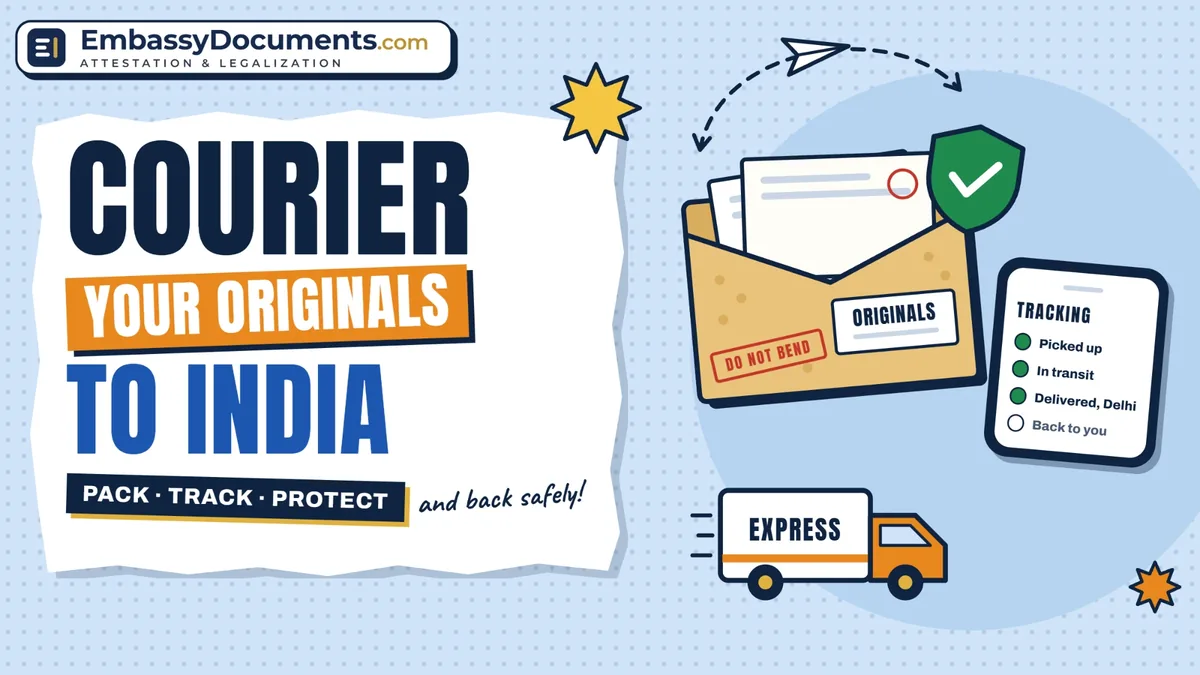
Before you send anything
- Email us scans of both sides of every document. We confirm which originals are needed so you do not send more than necessary.
- Keep full-colour scans or photos of everything you send, for your own records.
- Check that names match across documents and your passport. Fix mismatches before sending, not after.
That first point saves more trouble than any other. People routinely post four certificates when the process needs two, and every extra original in the envelope is extra risk for no benefit.
Send only what has to travel
Originals travel because a stamp or sticker is physically applied to them. Anything that does not need that should stay with you.
- Send: the original certificates being attested or apostilled.
- Send as copies: your passport pages, visa page, and any supporting identification. A clear photocopy or scan is enough.
- Never send: your passport itself. No legitimate agent needs it, and no part of this process requires it.
If you have only one copy of something irreplaceable and are nervous about posting it, say so. For a few document types and destinations there is a route that starts from scans, and it is worth checking whether yours is one of them before you take the risk.
Packing and paperwork
- Use a stiff document envelope or place certificates between two pieces of card. Do not fold or laminate them.
- Describe the contents as personal documents, no commercial value. This avoids customs duty questions.
- Include a note with your name, phone number, email and the address the documents should be returned to.
- Use a tracked service such as DHL, FedEx, UPS or your national post's tracked international option, and share the tracking number with us.
A plastic sleeve inside the card sandwich is worth the trouble in monsoon season. Envelopes get wet, and ink on an older certificate runs.
The customs declaration
This trips people up more than the packing does. Personal documents move across borders without duty in almost every case, but the declaration has to say what they are.
- Description: personal documents, no commercial value.
- Value: a nominal figure. Do not declare what the qualification is worth to you, or what it cost to obtain - that invites a duty assessment on paper with no commercial value at all.
- Do not describe the contents as certificates without qualification, which occasionally reads as share certificates to a customs system.
If a courier asks you to complete a commercial invoice, complete it with the same description and a nominal value. The form is routine; the wording on it is what matters.
Sending from where our clients usually send from
- The Gulf. Aramex and DHL both run well into New Delhi and are the common choices from the UAE, Qatar, Saudi Arabia and Kuwait.
- The USA and Canada. FedEx, DHL and UPS. Allow a little longer than the quoted transit time; clearance into India occasionally adds a day.
- The UK and Europe. DHL and Royal Mail's tracked international service are both used regularly by our clients.
- Australia and New Zealand. DHL and Australia Post's tracked international option.
Any tracked service works. What matters is that it is tracked, that you keep the number, and that somebody can sign for it at this end.
When it arrives
We check every document against the requirement for your destination on the day it arrives, and tell you the same day if anything is missing or looks likely to be refused. That is the point at which a problem is cheap to fix.
Through the process we photograph your document at each stage and send you the pictures, so you can see it is safe and moving rather than wondering.
If a shipment goes missing
It is rare with a tracked service, and in our experience almost always a delay rather than a loss - a shipment sitting at customs, or a failed delivery attempt nobody recorded.
Start with the tracking number and the courier, since only they can trace it. Tell us at the same time and we will watch from this end. If a document genuinely is lost in transit, the courier's terms decide what compensation applies, which is the reason for using a tracked service and declaring the contents honestly.
Practically: a lost degree certificate means applying to your university for a duplicate before anything else can happen. That is the real cost of a lost envelope, and it is why we ask you not to send more originals than the job needs.
Costs and return
Mailing costs to India and return courier costs are paid by the client. Once your documents are complete, we send them back by tracked courier and share the tracking number with you.
You can also give us your own DHL or FedEx account number and we will use that for the return instead. Some clients prefer this, particularly when a company is paying.
Tell us the return address at the start rather than at the end, and tell us if it changes - people move, contracts end, and an envelope sent to an address somebody has left is the one avoidable way this goes wrong at the last step.
Questions
Frequently asked questions
Any tracked international service works. DHL and FedEx are the most common choices among our clients because tracking is detailed and delivery to New Delhi is reliable.
Personal documents with no commercial value are not normally subject to duty. Describing the contents accurately helps avoid delays.
Insurance pays out a sum of money; it does not return your degree certificate. It is inexpensive and worth taking, but the real protection is sending only the originals that must travel and using a tracked service.
You can, and we would advise against it. Without tracking, neither you nor we can tell whether an envelope is delayed or gone, and there is no basis for a claim. The saving is small against what is inside.
No. A clear copy of the front and back pages is enough for every process we handle. Nobody should be asking you to post your passport.
Yes. A friend or relative in India can deliver them to our office directly. Tell us to expect them and give us their name, and let them know they do not need to wait.
Not sure where to start?
Send us the document and the destination country. We will reply within one working hour with the exact process, timeline and cost.