How to Apostille Indian Documents While Living Abroad
You do not need to fly to India. Here is how the process works when your documents travel by courier instead of you.
Read the guideOne sticker, accepted in over 120 countries. The simplest route — if your destination qualifies.
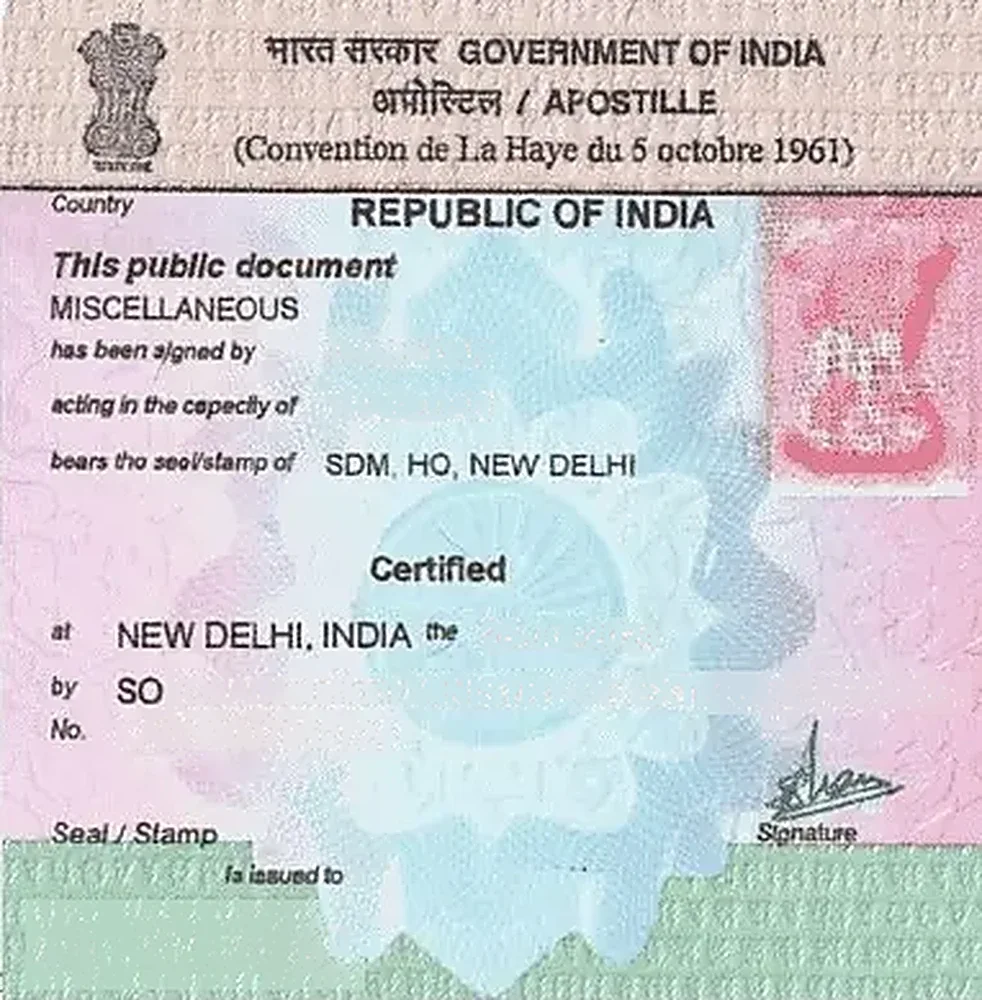
An apostille is a standardised certificate created by the Hague Convention of 1961. It is a numbered sticker applied to the reverse of your document by the Ministry of External Affairs, carrying a unique registration number that any member country can verify online against India's central register.
The advantage is substantial. Once a document carries an apostille, no embassy attestation is required at all. It is accepted directly by universities, employers and government departments in every Hague member country — the United Kingdom, the United States, most of Europe, Australia and over a hundred others. What would otherwise be a four-stage process becomes a two-stage one.
India joined the Hague Convention in 2005, and the MEA is the sole competent authority for issuing apostilles here. No state office, notary or private agency can issue one, whatever they may claim.
Most of the 120+ members of the Hague Convention. The ones we handle most often are the United Kingdom, United States, Italy, France, Spain, Netherlands, Portugal, Poland, Australia, New Zealand, Canada, Japan and South Korea.
The exceptions that matter most are the United Arab Emirates, Qatar and Kuwait, which are not Hague members and do not accept an apostille. Note that the Gulf is no longer uniform: Saudi Arabia joined in 2022, and Bahrain and Oman have been members for over a decade, and Viet Nam since September 2026. China and Germany are members but do not accept Indian apostilles, because of objections under the Convention.
If you are unsure which category your destination falls into, tell us the country before you do anything else. Getting this wrong is the most expensive mistake in the whole process, because the work has to be redone from the beginning.
Every apostille carries the same ten fields, in the same order, in every member country: the country of issue, the name of the signatory on the underlying document, their capacity, the authority whose seal it bears, the place and date of issue, the issuing authority, the certificate number, and the seal and signature of the issuing officer.
That standardisation is the entire point. A registrar in Milan does not need to recognise an Indian state seal — they only need to recognise the apostille format and verify the number.
Assuming an apostille works everywhere. It only works in Hague Convention countries. Send an apostilled document to Kuwait or Qatar and it will be refused at the other end, after you have paid for it.
Apostilling a photocopy. The sticker goes on the original. A notarised copy is not a substitute, and a document apostilled in copy form is usually rejected by the authority that asked for it.
Skipping the state stage. The most common rejection at the MEA counter, by a wide margin. No state authentication, no apostille.
Leaving it too late. Degree apostille depends on a university answering a letter. We cannot make that happen faster, and neither can anyone who tells you otherwise. Start before you have a deadline, not after.
Laminating the certificate. A laminated document cannot be stamped or stickered and often cannot be un-laminated without damage. If yours is laminated, tell us before you send it.
Using an agent who will not name the stages. If nobody will tell you which state department handled your document, or the work comes back implausibly fast, have the result verified before you rely on it.
HRD, Home Department or SDM verification, depending on the document type.
The verified original is submitted to the Ministry of External Affairs.
A numbered Hague apostille sticker is affixed, signed and registered.
Couriered back, ready to use — no embassy step required.
Indicative only — we confirm exact timelines for your specific document and state before you commit.
| Category | What is involved | Typical timeline |
|---|---|---|
| Personal documents | Birth, marriage, death, PCC, affidavits | 3-5 working days |
| Educational documents | Degree, diploma, mark sheets | 7-15 working days |
| Commercial documents | Invoices, certificates of origin, MOA | 3-6 working days |
Most of our clients live outside India. There is no need to travel: send your Indian documents to our New Delhi office and we handle every stamp.
Tell us the document and destination country. We confirm exactly what to send before you courier anything.
Send them to our New Delhi office by DHL, FedEx or any courier you prefer.
State verification, MEA apostille or attestation, and embassy legalisation, with an update at each stage.
Your completed documents are couriered back to your address anywhere in the world.
Courier charges for sending documents to us and for returning them are paid by the client.
You do not need to fly to India. Here is how the process works when your documents travel by courier instead of you.
Read the guideTwo different routes, and picking the wrong one costs you weeks. Here is how to tell which one your destination actually wants.
Read the guideFor jobs, licensing boards and further study in the United States, an MEA apostille on your Indian degree is usually all the authentication you need.
Read the guideYour originals are valuable and often hard to replace. A few simple precautions keep them safe on the way to New Delhi and back.
Read the guideMost members of the Hague Convention, including the United Kingdom, United States, Italy, France, Spain, Netherlands, Australia and Japan. China and Germany are exceptions and do not accept an Indian apostille. The UAE, Qatar and Kuwait are not members, so documents for those countries need embassy attestation instead. Saudi Arabia, Bahrain and Oman are members and do accept an apostille.
The apostille itself does not expire. However, many receiving authorities will not accept a police clearance certificate or similar document more than three to six months old, regardless of the apostille attached to it.
It does not need to be. One apostille is valid in every Hague member country simultaneously, so the same apostilled document can be used in several countries at once.
In most cases the original is required. Some countries accept an apostilled notarised copy, but many do not, and a rejected copy means starting again. We check the destination's rule before submitting.
The apostille has no expiry, but universities and visa authorities often set their own recency requirements for supporting documents. Check the deadline on your offer letter and work backwards from it.
It is a French word meaning a note or annotation, and it is the name the 1961 Hague Convention gave to a standard certificate that member countries agreed to accept from one another. In practice it is a numbered sticker applied by the Ministry of External Affairs to the back of your document. Its purpose is to replace a chain of embassy stamps with a single one that every member country recognises.
No. In India only the Ministry of External Affairs can issue an apostille. A notary can attest a copy, and notarisation is sometimes a required step before a document reaches the MEA, but a notary’s stamp is not an apostille and will not be accepted abroad in place of one. If somebody offers you a notarised apostille, they are selling you something that does not exist.
The Ministry accepts applications through registered collection agencies rather than directly from the public, so there is no counter you can walk up to and no public online form that ends in an apostille. The document itself must be physically submitted, because the sticker is applied to the paper. What can be done remotely is everything around it — which is how our clients abroad use us.
The original document, a copy of your passport, and an authorisation letter allowing us to submit on your behalf. Educational documents usually need mark sheets as well, because the university is asked to confirm them during verification. The exact list changes with the document type and the destination, so we confirm it for your case before you send anything.
Send us the document and the destination country. We will reply within one working hour with the exact process, timeline and cost.