Guide
How to Apostille Indian Documents While Living Abroad
You do not need to fly to India. Here is how the process works when your documents travel by courier instead of you.
Who issues an apostille for Indian documents
In India, apostilles are issued only by the Ministry of External Affairs (MEA) in New Delhi. An apostille from the MEA is accepted in every country that is a member of the Hague Apostille Convention, including the USA, the UK, Canada, Australia and most of Europe.
An apostille issued in India cannot be replaced by a stamp from a foreign notary or from an Indian embassy abroad. The document itself has to reach the MEA, which is why most people living overseas use an agent in New Delhi.
This surprises people. If you are in Toronto or Dubai, the Indian mission near you can attest some things, but it cannot apostille a degree issued by an Indian university. That authority sits with the MEA alone, and the paper has to be in front of it.
What an apostille actually looks like
It is a printed sticker fixed to the back of the document, carrying a unique identification number. It is not a rubber stamp, and it is not printed onto the face of your certificate. Nothing on the front of your degree changes.
Underneath it, or on an earlier page, you should also see the state-level authentication that came first. An apostille with no state verification behind it is the first thing that should make you suspicious of how a document was handled.
The sticker is the thing the receiving authority abroad will look for. If somebody returns a document to you with only a notary's seal and calls it an apostille, it is not one, and it will be refused.
Which documents can be apostilled, and which cannot
Most Indian public documents can be: degrees, diplomas, mark sheets and transcripts; birth, marriage and death certificates; police clearance certificates; affidavits and powers of attorney; medical certificates; and commercial documents such as invoices and certificates of origin.
What cannot be apostilled is anything that is not a document issued or certified by a recognised authority. A photocopy nobody has certified, a printout of an email, a letter from a friend - none of these become official by having a sticker put on them, and the MEA will refuse them.
Two cases catch people out. First, documents issued by a foreign authority cannot be apostilled in India, even if you are Indian: a degree from a British university is apostilled in the UK, not here. Second, expired or superseded documents are usually refused, so a police clearance certificate more than six months old normally has to be obtained again.
The steps, in order
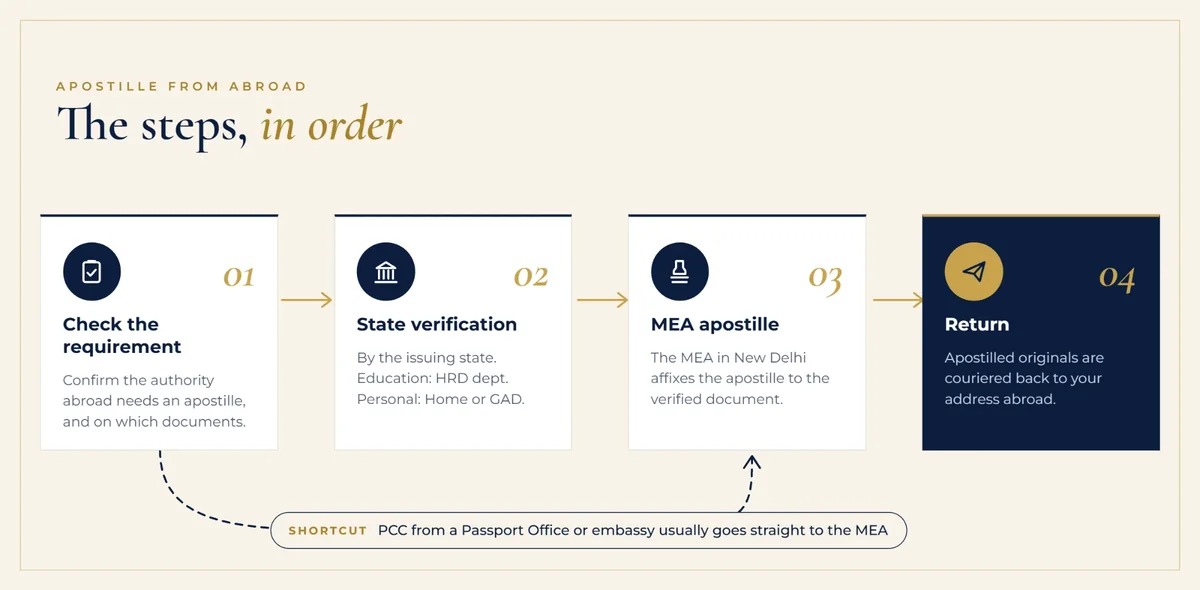
- Check the requirement. Confirm with the university, employer or authority abroad that an apostille is what they need, and which documents it applies to.
- State verification. Most documents are first verified by the state that issued them: educational certificates by the state education or HRD department, personal documents such as birth and marriage certificates by the state home or general administration department.
- MEA apostille. The verified document is submitted to the MEA, which affixes the apostille.
- Return. The apostilled originals are couriered back to your address abroad.
Some documents skip the state step. Police clearance certificates issued by an Indian Passport Office or embassy, for example, can usually go straight to the MEA.
The state stage is where the time goes
Everything before the MEA is where a timeline is won or lost. The MEA itself is fast once a document reaches it. The stage before can take days or it can take a month, and which one depends on the document.
For an educational document, the state HRD department writes to your issuing university and waits for written confirmation that the degree is genuine and the record matches. Some universities answer within a week. Some take a month. A few charge their own verification fee, which we confirm with you before paying.
For personal documents - birth, marriage, police clearance - the route is the Home Department or an SDM, and neither has to write to anybody. That is why a birth certificate is finished while a degree is still waiting.
There is no way to make a university answer faster, and we would rather tell you that at the start than promise a date we cannot hold. If somebody offers you a degree apostille in three days, they are either using the SDM route instead or the promise is not real.
How to do it from outside India
Start by sending a scan or photo of each document. We check it for problems that cause rejections, such as lamination, name mismatches between documents or missing seals, and tell you exactly which originals to send.
You then courier the originals to our New Delhi office by DHL, FedEx or any tracked courier. Mailing and return courier costs are paid by the client. We update you at each stage and courier the completed documents back.
We photograph the document at each stage and send you the pictures. For somebody who has posted an irreplaceable certificate to another country, seeing it is worth more than being told about it.
What we check before you send anything
Most rejections are avoidable and almost all of them are visible in a scan. The ones we see most often:
- Lamination. A laminated certificate cannot have a sticker fixed to it and often cannot be un-laminated without damage. Tell us before you send it.
- Name mismatches. A degree in a maiden name and a passport in a married name needs a linking document, usually the marriage certificate, attested alongside.
- Missing signatures or seals. Universities occasionally issue certificates without the registrar's seal. The issuing institution has to correct this, not us.
- The wrong document. People often send a degree when the authority abroad asked for the transcript, or a provisional certificate when the final degree exists.
- Damage. Tears at a fold line, water damage, a certificate trimmed to fit a frame. Some of this is workable, some is not, and it is better to know first.
How long it takes
The state verification step is the main variable, because every state works at its own pace. Once a document reaches the MEA, the apostille itself is quick. Add courier time in both directions. We give you a realistic timeline for your specific documents before you send anything.
As a rough shape: personal documents are usually a matter of a week or two once they reach us, educational documents considerably longer because of the university stage, and commercial documents somewhere in between. Those are estimates from experience, not guarantees, and we will say so plainly if your case looks like an outlier.
Start earlier than you think you need to. The single most common thing we hear is from someone with a visa appointment or a job start date three weeks away and a degree that has not begun verification.
What you get back
Your original documents, unchanged on the front, carrying the apostille sticker on the back, returned by the courier you chose, with the tracking number sent to you the day they leave our office.
Keep them. An apostille does not expire in itself, though some authorities abroad will not accept one older than six months for a particular application - that is their rule about the age of the paperwork, not a property of the apostille.
Questions
Frequently asked questions
Yes, but they will need to deal with the state department and the MEA collection process themselves. Many people abroad prefer to courier documents directly to an agent so nobody has to take time off work.
Apostilles are generally placed on original documents. Some documents, such as degrees, are sometimes apostilled on a notarised copy, depending on what the receiving authority accepts. Ask them first, then ask us.
You need attestation instead: MEA attestation followed by attestation at that country's embassy in New Delhi. Our country guides explain the chain for each destination.
The apostille itself does not. But some authorities abroad will only accept documents authenticated within the last three or six months for a given application. Check the rule where you are applying before you start, because it decides whether you need this done now or later.
For a few document types and destinations, yes. For most, no - the sticker is physically fixed to the original, so the original has to travel. We tell you which case yours is before you post anything.
If it is rejected because of something we got wrong, we correct it and resubmit at our own cost. If it is rejected for a reason outside our control - a university that will not confirm its own record, a certificate the issuing authority cannot verify - we tell you immediately and explain the options. Government fees already paid cannot be recovered by anyone.
No. The document has to be an Indian public document. Your own nationality is irrelevant - we regularly apostille Indian birth certificates for people who are now citizens of other countries.
Not sure where to start?
Send us the document and the destination country. We will reply within one working hour with the exact process, timeline and cost.