Guide
Every Stamp on Your Attested Document, and What Each One Means
Attested documents come back carrying marks most people cannot read. Here is what each one is, and how to check nothing was skipped.
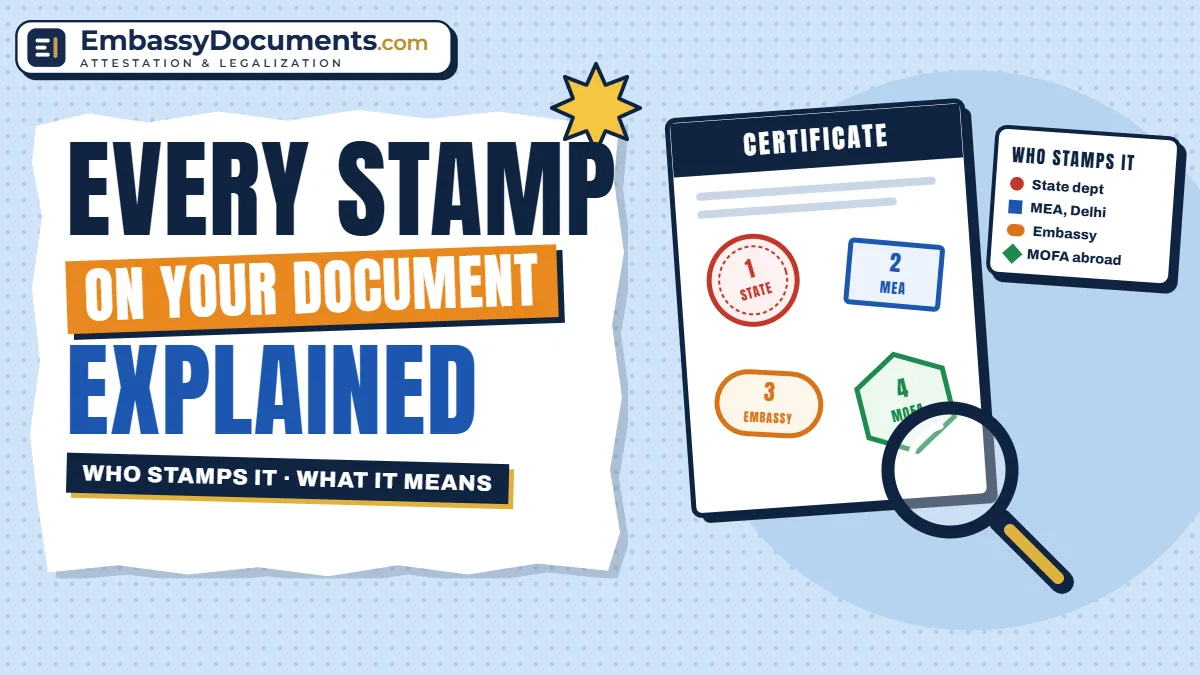
A document that has been through the chain comes back with several marks on it: a stamp from a state department, something fixed to the back, perhaps a seal in a corner from an embassy. Almost nobody is told what they are looking at.
That matters for two reasons. The first is that a missing stage is far easier to fix before the document is submitted abroad than after it is refused. The second is that you paid someone to complete a sequence of steps, and you are entitled to see that each one happened.
This page sets out every mark your document can carry, who applies it, and what its absence means. It applies whether we handled your file or somebody else did.
First: which route was your document on?
The marks you should expect depend entirely on the destination, and the two routes look completely different when they come back.
| Apostille route | Full legalisation chain | |
|---|---|---|
| Where it applies | The 127 countries that accept an apostille from India | Everywhere else, including the UAE, Qatar and Kuwait |
| Marks on the document | Two | Three before it leaves India, four in total |
| Final mark applied in | India | The destination country, after it leaves you |
If you are not sure which applied to you, the destination decides it, not the document type. Apostille and embassy attestation set out which is which.
The state stamp
Applied by: the authority in the state that issued the document. For a degree or any educational certificate that is the state HRD or education department. For a birth certificate, marriage certificate or police clearance certificate it is the Home Department or an SDM.
Where it sits: on the document itself, usually on the reverse or in a margin, as an inked stamp with a signature across or beside it.
What it proves: that the issuing institution confirmed the record is genuine. For a degree this is the stage where the state writes to your university and waits for an answer, which is why it takes the longest.
If it is missing: nothing downstream should exist. The Ministry legalises on the basis of the signatures of designated state authorities, so an MEA mark without a state mark beneath it is the single clearest sign that something went wrong.
The MEA mark — and why it is a sticker on one route and a stamp on the other
This is where most of the confusion sits, because the Ministry of External Affairs does two different things depending on the destination.
On the apostille route it applies an apostille: a separate certificate roughly nine centimetres square, fixed to the back of the document, carrying a computer-generated number.
On the full chain it applies MEA attestation instead — an inked stamp, not a sticker. People who were expecting the sticker often assume a stage was skipped. It was not; a document going to the UAE is not supposed to carry one.
An apostille is the same everywhere it is issued, and that is the point of it. It carries the same ten fields in the same order in every member country: the country of issue, the name of the signatory on the underlying document, their capacity, the authority whose seal it bears, the place and date of issue, the issuing authority, the certificate number, and the seal and signature of the issuing officer. A registrar in Milan does not need to recognise an Indian state seal. They need to recognise the format and check the number.
If it is missing: no embassy in New Delhi will look at the document, and no authority abroad will accept it.
The embassy mark
Applied by: the destination country’s embassy in New Delhi. Only on the full chain — a document going to a Convention country never receives one, and does not need one.
Where it sits: usually a sticker or an inked seal on the reverse, often overlapping or adjacent to the MEA stamp.
What it proves: that the destination country has recognised the Indian government’s attestation. It is a statement by them about us, which is exactly why a Convention member does not need to make it — the treaty already says it.
If it is missing on a Gulf file: the chain is incomplete and the document will be refused on arrival.
The MOFA mark, which you will not see yet
MOFA attestation is the last stage for the UAE, Qatar and Kuwait, and it happens in the destination country, after the document has left India.
So a correctly completed Gulf file comes back to you with three marks, not four. The fourth is applied at the other end, usually by the employer once the candidate arrives.
This causes a great deal of unnecessary worry, and occasionally causes people to pay twice. Ask your employer who is arranging it before paying anyone for it.
Marks that appear on some documents and not others
- A notary stamp. Some document types are notarised before the state stage. An affidavit, for instance, begins life in front of a notary.
- A Chamber of Commerce stamp. Commercial documents route through a Chamber of Commerce rather than a state department, so an invoice or certificate of origin carries a different first mark from a degree.
- A translator’s attestation. Where the destination required a translation, the translation carries its own certification, and in some countries that has to be legalised too.
- A second state stamp. A file containing both educational and personal documents went to two different departments, so the marks will not match across the set. That is correct, not an error.
How to check the work, whoever did it
Five minutes, with the documents in front of you.
- Count the marks against your route. Two for an apostille, three for a Gulf file leaving India. A Gulf document with only two is missing the embassy stage.
- Find the state mark underneath everything else. It should be the first thing applied and it should name a department in the state that issued the document, not the state you live in.
- Read the apostille number. It is computer-generated and unique. A legible number is the part an authority abroad will check.
- Check the name on every mark matches the name on the certificate.
- Check the document is the one you sent. Originals should come back as originals.
If something does not match, ask the person who handled it which department applied which mark and on what date. Anyone who did the work can answer that immediately.
What we will do
Send us photographs of the marks and we will tell you what each one is, whether the sequence is complete for your destination, and what is missing if anything is. We do this whether or not we handled the file.
We say that plainly because the commonest way people lose money in this sector is paying for stages that were never completed, and the only defence is being able to read what came back.
Questions
Frequently asked questions
Two on the apostille route: the state mark and the MEA apostille. Three when it leaves India on the full chain: state, MEA attestation and the embassy. The fourth, MOFA, is applied in the destination country afterwards.
Because it is going to a country outside the Hague Convention. The Ministry applies an apostille for member countries and an attestation stamp for everywhere else. For the UAE, Qatar or Kuwait a stamp is correct and a sticker would be wrong.
The same ten fields in every member country, in the same order: country of issue, the name of the signatory on the document, their capacity, the authority whose seal it bears, the place and date of issue, the issuing authority, the certificate number, and the seal and signature of the issuing officer.
On the back of the document, as a separate certificate roughly nine centimetres square. It is fixed to the paper, which is why a laminated certificate cannot be apostilled until the lamination is removed.
The number is the thing an authority abroad checks, and it is unique to that certificate. Verification routes have changed over time and differ by document, so send us a photograph and we will tell you how yours can be checked rather than pointing you at a page that may have moved.
Probably not. MOFA attestation happens in the destination country after the document leaves India, so a correctly completed file comes back with three marks. Confirm with your employer who is arranging the final stage.
No. Educational documents are verified by the state HRD or education department and personal documents by the Home Department or an SDM. Different offices, different marks, both correct.
It usually has to be completed in order, which means going back to the point where the sequence broke rather than starting again from nothing. Send photographs and we will tell you where it stopped.
Not sure where to start?
Send us the document and the destination country. We will reply within one working hour with the exact process, timeline and cost.